When it comes to industrial cooling and commercial air conditioning systems, screw chillers stand out as the workhorses that keep critical operations running smoothly. Among the various types available, water cooled and air cooled screw chillers dominate the market, each offering distinct advantages tailored to specific needs. The core difference between these two lies in their heat dissipation mechanisms, which ripples through every aspect of their performance, cost, and application. Let’s dive deep into the key distinctions to help you make informed decisions for your cooling requirements.
Core Working Principles: How They Dissipate Heat
The fundamental divergence between water cooled and air cooled screw chillers starts with how they remove heat from the refrigerant cycle—a process that directly impacts efficiency and system design.
Water Cooled Screw Chillers: Water as the Heat Transfer Medium
Water cooled models rely on a closed-loop water system to expel heat. The system consists of a shell-and-tube condenser where high-temperature, high-pressure refrigerant gas comes into contact with cooling water flowing through copper tubes. As water has a specific heat capacity 4 times higher than air, it efficiently absorbs the refrigerant’s heat, condensing it into a liquid. This heated water is then pumped to a cooling tower, where it releases heat into the atmosphere through evaporation before returning to the condenser. The entire cycle requires auxiliary components: cooling towers, circulation pumps, and water treatment systems to maintain water quality.
Air Cooled Screw Chillers: Air as the Heat Transfer Medium
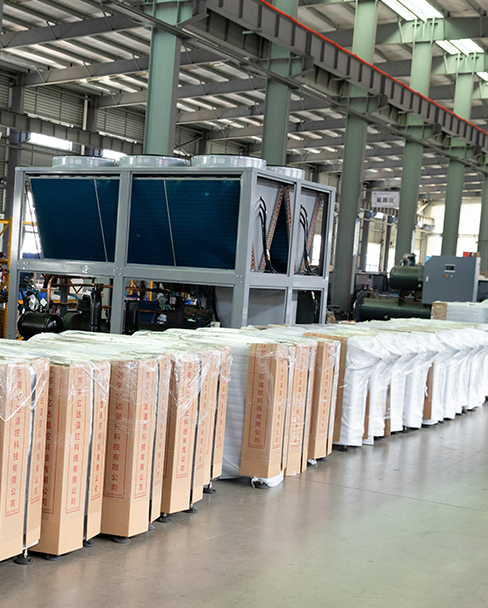
Air cooled chillers simplify heat dissipation by using forced air convection. Their condensers feature V-shaped finned tube banks (increasing heat exchange area by 25% compared to traditional designs) paired with axial fans that blow ambient air over the coils. The heat from the refrigerant is transferred directly to the air, which is then expelled into the environment—eliminating the need for water-related auxiliary equipment. Modern models often incorporate variable frequency drive (VFD) fans, enabling stable operation even at -15℃ low temperatures.
Energy Efficiency: A Significant Performance Gap
Efficiency is a critical factor in long-term operating costs, and here the two types show substantial differences driven by their heat transfer media.
Water Cooled Chillers: Superior Efficiency for Large-Scale Needs
Thanks to water’s exceptional heat-carrying capacity, water cooled screw chillers boast significantly higher efficiency. Industry data shows their coefficient of performance (COP) typically ranges from 6.0 to 6.8, outperforming air cooled models by 30%-40%. A semiconductor manufacturing plant case study revealed that water cooled units achieved a year-round COP exceeding 6.0, surpassing the average 5.0 requirement for municipal buildings. This efficiency advantage is most pronounced in large-scale applications (over 200RT cooling capacity), where continuous operation amplifies energy savings.
Air Cooled Chillers: Moderate Efficiency with Flexibility
Air cooled chillers have a lower but still reliable COP, usually between 3.2 and 3.8. Their efficiency is more sensitive to ambient temperatures—when outdoor temperatures exceed 35℃, cooling capacity can drop by 15%-20%. However, their efficiency improves in cold climates: a Beijing pharmaceutical factory recorded a 22% COP increase at -5℃. For small to medium applications (under 800kW cooling capacity), their efficiency is sufficient, and their installation flexibility often offsets higher energy consumption.
Installation & Space Requirements: Complexity vs. Simplicity
The two chiller types differ drastically in installation complexity, space needs, and site dependencies.
Water Cooled Chillers: Higher Space & Infrastructure Demands
Water cooled systems require more indoor space for the chiller unit itself, plus additional outdoor area for cooling towers and pump rooms. The installation process involves piping connections between the chiller, cooling tower, and pumps, extending the construction period by 40% compared to air cooled models. They also demand a reliable water source—making them unsuitable for arid regions. However, their compact unit size (relative to cooling capacity) makes them ideal for data centers and industrial facilities where indoor space is available but outdoor space may be limited.
Air Cooled Chillers: Plug-and-Play Convenience
Air cooled chillers excel in installation flexibility. They can be mounted outdoors (rooftops, open yards) without requiring indoor space or water supply, saving 30% of installation area compared to water cooled systems. The installation process is straightforward: just connect the chilled water pipes and electrical supply, reducing construction time significantly. A northwestern China photovoltaic power station project demonstrated that air cooled units cut the construction period by 40% while avoiding winter freezing risks of water systems. They only need 0.5m of surrounding maintenance space, making them perfect for urban commercial buildings and space-constrained sites.
Cost Considerations: Initial Investment vs. Long-Term Expenses
Cost analysis must cover the entire lifecycle—initial purchase, installation, operation, and maintenance.
Initial Investment
- Water Cooled Chillers: Higher upfront costs (30%-40% more than air cooled models for the same cooling capacity). The total investment includes the chiller unit, cooling tower, pumps, piping, and water treatment equipment. Cooling towers alone account for 20% of the total investment.
- Air Cooled Chillers: Lower initial costs due to the absence of auxiliary water systems. Their simplified design means installation labor costs are also 20%-30% lower.
Operating & Maintenance Costs
- Water Cooled Chillers: Lower energy costs thanks to higher efficiency—an automotive factory producing 300,000 vehicles annually saved 850,000 kWh per year by switching to water cooled systems. However, maintenance is more complex: monthly water quality testing, quarterly condenser tube cleaning, and chemical water treatment to prevent scaling add up to 15% of the equipment’s total cost over its lifetime.
- Air Cooled Chillers: Higher energy costs but simpler maintenance. Routine tasks include quarterly fin cleaning, annual fan bearing lubrication, and oil replacement every 3-5 years. Annual maintenance costs are only 2% of the equipment price, compared to 3%-5% for water cooled systems. They also eliminate water-related expenses like water fees and chemical treatments.
Environmental Adaptability & Application Scenarios
Choosing the right chiller depends heavily on local climate, water availability, and usage requirements.
Water Cooled Chillers: Ideal for Stable, High-Demand Environments
Their stable performance under high temperatures (maintaining 95% capacity at 40℃) makes them perfect for 24/7 operating facilities like data centers, pharmaceutical plants, and chemical factories. They thrive in regions with moderate to high humidity and accessible water sources. However, they require protection in cold climates (e.g., ethylene glycol solutions or electric heat tracing in northeastern China), increasing system complexity.
Air Cooled Chillers: Perfect for Water-Scarce or Flexible Settings
Air cooled models are the go-to choice for arid regions (e.g., northwestern China) or islands where water is scarce. They also excel in temporary cooling needs (construction site offices, field hospitals) and rooftop installations (shopping malls, office buildings). Their ability to operate at -20℃ without freezing issues makes them suitable for cold climates, while their noise level (75-82dB(A) at 1m) can be mitigated with soundproof enclosures for noise-sensitive areas like hospitals.
Conclusion: Choosing the Right Chiller for Your Needs
The decision between water cooled and air cooled screw chillers boils down to balancing your cooling capacity requirements, budget, site conditions, and long-term operational goals.
Opt for water cooled chillers if you have large-scale cooling needs (over 200RT), access to water, and prioritize energy efficiency for continuous operation—they deliver lower operating costs and higher performance despite higher upfront investments.
Choose air cooled chillers if you have limited space, scarce water resources, or need quick installation for small to medium applications—their flexibility, lower initial costs, and simplified maintenance make them a practical solution for dynamic or resource-constrained environments.
In some cases, a hybrid approach (water cooled for base load + air cooled for peak load) can optimize efficiency and cost, as demonstrated by a Yangtze River Delta commercial complex that saved 230,000 yuan annually in electricity bills. By understanding these key differences, you can select a chiller system that aligns with your technical requirements and business objectives.
Have you encountered other problems with water temperature controllers? Share your experiences in the comments below!
 English
 Español
 عربي
عربي Melayu
 Tiếng Việt



 IPv6 network supported